
Words of Impact with Julie Boulton
It was so lovely to see so many of you out on a chilly August evening to talk about sustainable fashion.
We didn’t have time on the night for Jules to answer all of your questions. So, we asked Jules to provide her thoughts in writing for you all.
We do want to reiterate one answer Jules gave on the evening as we think it is spot on. In response to the audience question, “What can the ACT Government do to help push a sustainable fashion industry?” Jules suggested that it’s really quite simple. We need the government – and our wonderful community – to support local centres like CEC to thrive. We provide spaces for people to come together to swap, share, repair their clothes, along with a whole host of other products and services. All of it is focused on building a stronger, more resilient Canberra community. And we would love for you to join us as a member, if you have not already.
Please do keep an eye out for repair cafes and for the visible mending workshops that we will run again in the new year. If you’d like to get more involved also, we would be very happy to chat to you about running a clothes swap or hosting an event about sustainable fashion.
We’re here for all of it.
The notes from Jules’ talk can be found here and her substack link is here.
Jen

System disrupted: check out Julie’s substack
Impact hour with julie boulton: continued…
1. Why is Australia's cotton considered the best?
Is Australian cotton the best? Answering that is more complicated than it might seem. What is cotton being compared to, and are we all clear on what best actually is?
These sites are worth looking at to understand the research and development that has gone into Australia’s cotton industry and the fibre that is produced as a result.
2. Is there somewhere in Canberra to get puffers repaired?
Check with the place of purchase as they may have in-house repair services, and, in some cases, they may partner with a third-party repairer (ie Remote Equipment Repairers in Victoria).
Another option is to take your puffer to a local repair café. Find details here. Have a cup of coffee and make a new friend here while your puffer is restored. This is a win-win situation!
3. Is it true that the production of bamboo cotton requires enormous amounts of water?
This is complicated and honing in on one metric does not provide a complete picture of the impacts that turning either of these raw materials into a textile has. Both bamboo and cotton require water to grow, and water to turn the fibre into a textile. There is some research saying bamboo requires less water, especially for growing. But what you would also want to consider is the ecosystem benefits of growing the raw ingredient, the production processes involved, the chemicals needed to transform the materials, and how those chemicals are disposed (ie into the water supply). This is all before we have even started to talk about the logistics, the use, the wear and what can happen at the end of life for each material. I argue that all of this has to be considered, along with being clear about what “good” looks like for each material.
Would it be an idea to copy European initiatives such as the Seam, a platform connecting tailors with people who require alterations with government subsidy?
Any incentive for repair would be a great thing. In addition, I would like to see regulations in place which mandate that a product is fit for purpose and is designed for repair (and can be repaired easily and is cost-effective to do so).
4. Is there a prospect where companies doing the right thing will be subsidized.
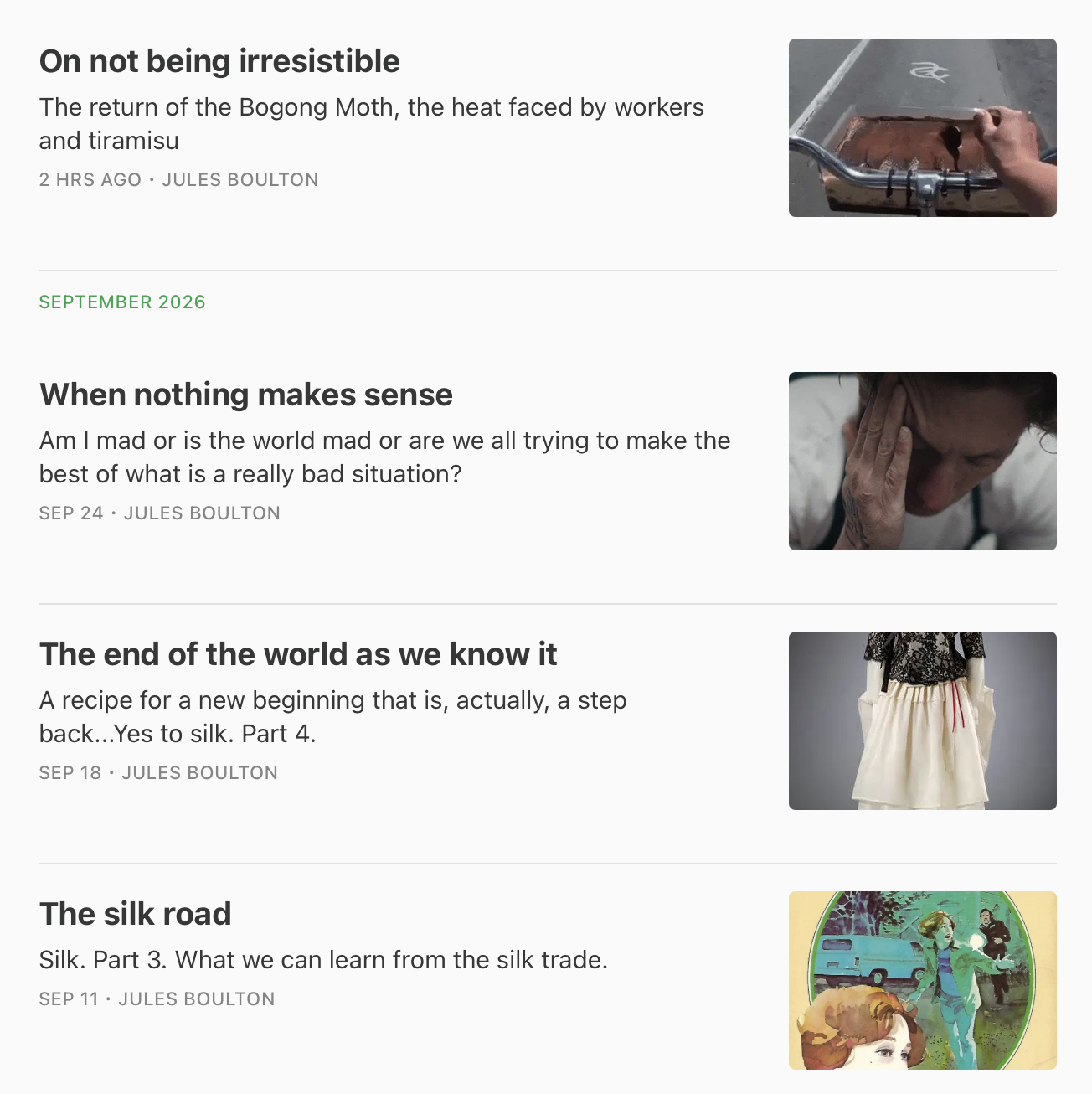
A look into Julie’s recent works
This can take place through product stewardship schemes or extended producer responsibility schemes. These are frameworks (voluntary or mandatory) that impose a cost for garments placed on the market. The collective amount is used to fund parts of the system that are perhaps not working well or that need further incentivising, ie like setting up collection or recycling facilities. To encourage the initial production of more responsible products, schemes may lower the cost deemed to meet certain criteria. This is called eco-modulation (amending the cost due to the ecological benefits of the product).
Under Australia’s (voluntary) national product stewardship scheme (Seamless) members receive a 25% reduction in the contribution they must pay for every garment that meets the eco-modulation criteria. The current criteria is that a garment is made from a mono-material or single fibre at a rate of at least 95%. However, this may well change in the future. This brief is worth reading to find out more.
5. Do you know what happens to clothing donated to Resmart?
This resource is super helpful and should tell you all you need to know about what happens to your clothes donated to Resmart.